read
In a context where India is establishing itself as a major scientific player and a global hub for innovation, the university is affirming its ambition: to make India a permanent fixture on its international map, with the aim of building lasting strategic partnerships combining training, research and innovation.
Consolidating what already exists
Already structured scientific cooperation
Although student flows have remained limited until now – however, it should be noted that since 2017, students from St Stephen’s College (JNUniversity) and a few other Indian institutions have been regularly enrolled in the Erasmus Mundus Master’s programme in Nuclear Physics – solid scientific cooperation already existed: several researchers from laboratories such as LMNO and CRISMAT collaborate with Indian partners, although without any formal agreements.
UNICAEN’s Franco-Indian relationship is also part of a consolidated research framework with the creation of the International Joint Laboratory (LIA) IFLASC2 – “Indian-French Laboratory of Solid State Chemistry 2”, launched on 1 January 2018 (scheduled to end in 2026). On the Indian side, this LIA brings together the Indian Institute of Science (Bangalore) and the IITs of Madras (Chennai) and Bombay; on the French side, the CNRS, the University of Bordeaux (ICMCB), the University of Strasbourg (IPCMS), ENSICAEN and UNICAEN via CRISMAT. A new project is currently under consideration to extend this dynamic beyond 2026.
Preparing for exchanges: international classes
At the same time, UNICAEN is participating in the International Classes programme launched by the French government to welcome 30,000 Indian students by 2030. This programme aims to structure the reception of Indian students through an intensive year combining French as a foreign language, subject-specific courses and university methodology before entry into L1 (science, economics and management) or integrated preparatory classes for engineering studies. Since 2025, the programme has also been open to other countries (South Africa, Nigeria, Kenya, Vietnam, Indonesia, China), strengthening its international appeal.
Towards new opportunities for mobility
From APAIE 2025 to the RUSH 2026 dynamic
UNICAEN’s participation in APAIE 2025 (Asia-Pacific Association for International Education) was a first strategic step in prospecting and positioning itself in the Indo-Pacific region. This was followed up by the 2026 High-Level University and Scientific Meetings (RUSH), organised in New Delhi as part of the Franco-Indian Year of Innovation and the World Summit on Artificial Intelligence.
Hosted at AIIMS (All India Institute of Medical Sciences, New Delhi), RUSH 2026 brought together more than 600 participants from over 300 French and Indian institutions, making it the largest Franco-Indian academic and scientific gathering ever organised. The event, inaugurated by AI Ambassador Clara Chappaz, was marked by the presence of French President Emmanuel Macron, underscoring the strategic importance of the bilateral partnership.
Highlights included 23 conferences, three parallel workshops on artificial intelligence, a round table on child protection and AI, a symposium on brain health, and the inauguration of the Indo-French Centre for AI in Health, supported by Sorbonne University and AIIMS. The second day of RUSH also provided an opportunity to engage in discussions with eleven Indian institutions, opening up prospects in science, engineering, artificial intelligence, language learning, student and teacher mobility, internships and joint research projects.
The signing with NIT Jalandhar: a founding milestone
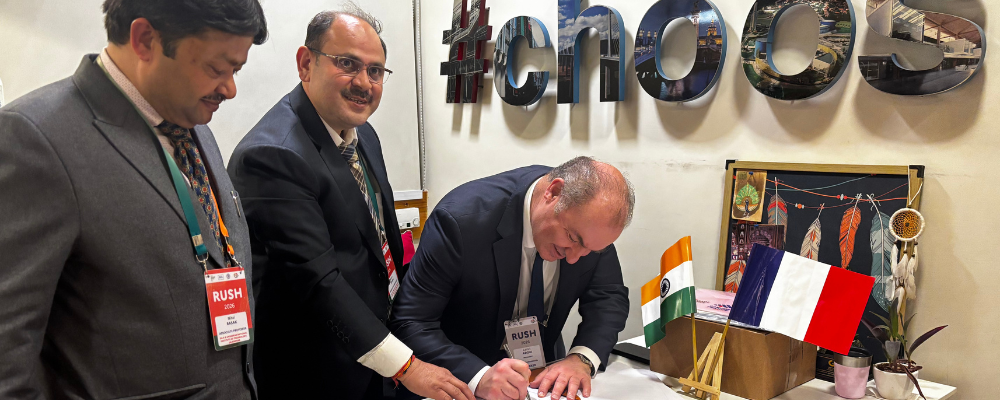
During RUSH 2026, the President of UNICAEN, Lamri Adoui, signed a tripartite international mobility agreement with ENSICAEN and NIT Jalandhar. This agreement, initiated thanks to the scientific links established between Professor Kiran Singh of NITJ and the CRISMAT laboratory (Wilfrid Prellier) over several years, illustrates the capacity of research cooperation to foster the emergence of structuring institutional partnerships. It aims to develop mobility in master’s and doctoral programmes and to consolidate sustainable scientific collaborations between institutions.
Between structuring existing projects and exploring new possibilities, this global dynamic definitively positions India as a priority area in the international development of the University of Caen Normandy.
Contacts : International Development Centre | Carré International: intl.projets@unicaen.fr